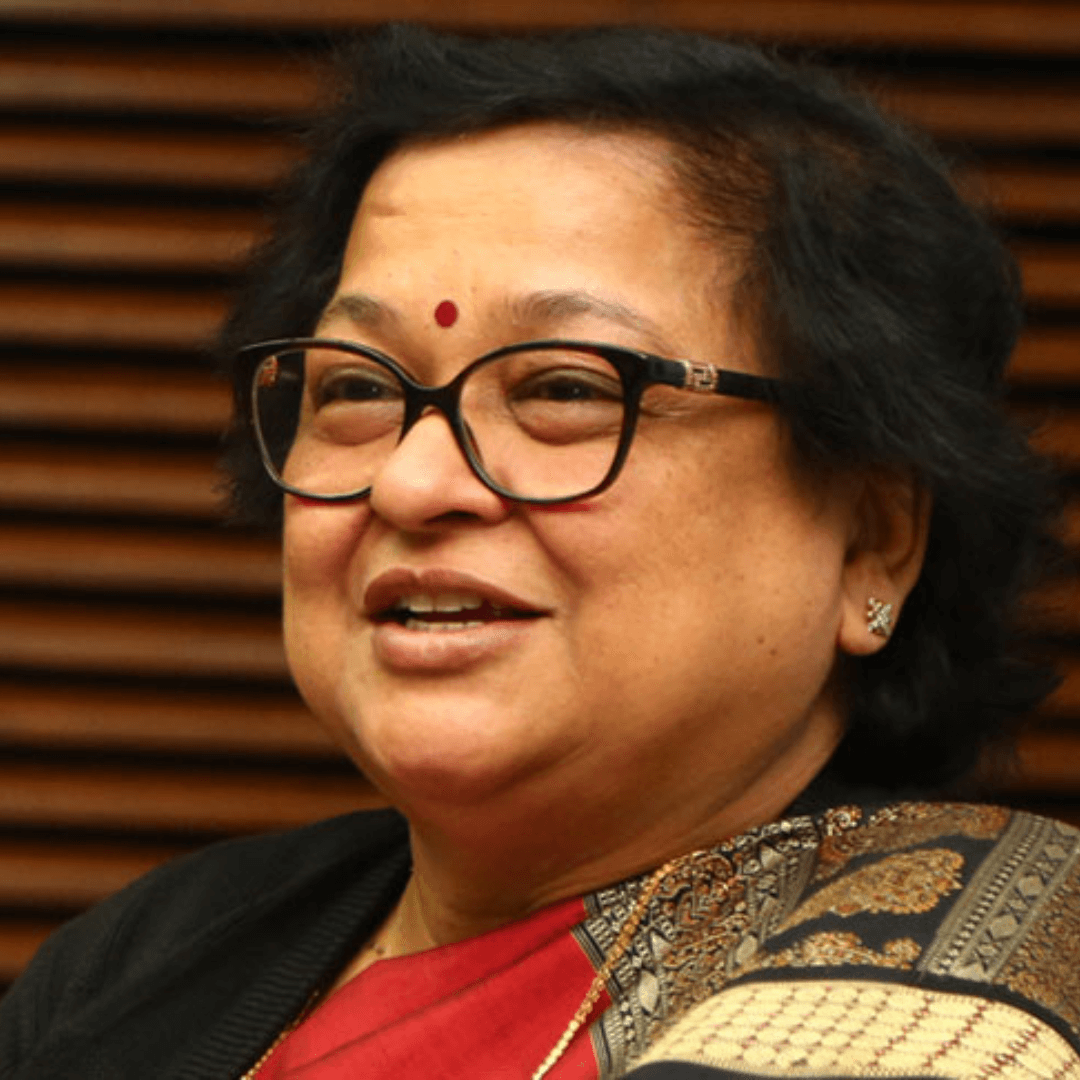
About the Chairperson
About Chairperson
Justice Gita Mittal
Justice Gita Mittal (Retd.)
Justice Gita Mittal is the former Chief Justice of the High Court of Jammu & Kashmir and the former Acting Chief Justice of the High Court of Delhi. Throughout her distinguished judicial career, she has been widely recognised for her pioneering contributions to judicial reforms, access to justice, gender justice, alternative dispute resolution, and the protection of vulnerable communities.
Justice Mittal presently serves as Chairperson of (i) Vulnerable Witness Committee and Committee on Relief and Rehabilitation of Internally Displaced Persons in Manipur during the Violence, both constituted by the Supreme Court of India; Chairperson, Broadcasting Content Complaints Council (BCCC); Administrator, All India Tennis Association, appointed by the High Court of Delhi in 2026; Council Member, Mumbai Centre for International Arbitration (MCIA); Member, Governing Body, Lady Shri Ram College for Women; Member, Advisory Bodies of the Cornell Law School; and the School of Law, Manav Rachna University; Member, Governing Council, the Vedica Scholars Programme for Women; Member, International Association of Women Judges (IAWJ); Patron, Justice Leila Seth Foundation; President (International), Indian Scout and Guide Fellowship and Member, Advisory Board, SAMPARK.
Justice Mittal has held several prestigious academic, judicial and institutional positions, including Chancellor, National Law University, Delhi; Special Commissioner, Independent Special Commission, SOS Children’s Villages; Chairperson, Committee of Administrators, Table Tennis Federation of India; Member, Governing Council and Executive Committee, Indian Law Institute; Member, Delhi University Court; Member, Governing Body, Ram Lal Anand College, University of Delhi; Member, Academic Council, National Law University, Jodhpur; Judge Nominee, SAARC Law India Chapter, for over twelve years.
Justice Mittal has delivered several landmark judgments that have significantly influenced legislation, judicial administration and legal reform in India. During her judicial career, she spearheaded numerous institutional initiatives, including establishment of international arbitration and mediation centres, development of innovative judicial infrastructure, capacity-building programmes for judges, prosecutors, police officers, lawyers and other stakeholders, community outreach initiatives to improve access to justice, including Insaaf Ki Dastak in the Union Territory of Jammu & Kashmir and Ladakh and Main Honhaar Hoon.
Justice Mittal is an alumna of Lady Irwin Higher Secondary School, Delhi; Lady Shri Ram College for Women, University of Delhi and Campus Law Centre, Faculty of Law, University of Delhi.
Justice Mittal is a globally respected jurist and has frequently been invited to deliver lectures and keynote addresses on constitutional law, human rights, gender justice and judicial reforms. She has addressed several prestigious international forums, including an invitation by Pope Francis to Vatican City.
Her distinguished contributions have been recognised through numerous national and international honours, including Nari Shakti Puraskar (2018), conferred by the President of India; Arline Pacht Global Vision Award by the International Association of Women Judges (the only Indian judge to receive this honour); Justice P.N. Bhagwati Award, SriRam Panchu National Impact Award in Mediation Social Awareness (2023); Bangladesh International Mediation Society (BIMS) Mediation Award (2021); V-WA 50 Lifetime Achievement Award (2021), IIAM Excellence Award for Women in ADR (2026); Accreditation Certificate in Leadership and Mediation from the Straus Institute for Dispute Resolution (2022); Distinguished Alumna Award (2008), presented by the Vice-President of India; President’s Guide Certificate. She has also been conferred the Doctor of Philosophy (Honoris Causa) from Manav Rachna University.
During her judicial career, Justice Mittal has extensively adjudicated upon and contributed through judgments, lectures and publications to diverse areas of law, including Constitutional Law, Human Rights, Gender Justice, Sexual Harassment at Workplace, Sexual Violence, Human Trafficking and Acid Attack Cases, Domestic Violence and Family Law, Corporate and Commercial Law, Company Law, Civil and Property Law, Intellectual Property Law, Environmental Law, Disability Rights, Reproductive Rights, Corporate Social Responsibility, Death Penalty Jurisprudence, Impact of Religion, Culture and Tradition on Judicial Decision-making, Access to Justice, Arbitration, Mediation and Conciliation
Pioneer of Vulnerable Witness Deposition Centres in India
Justice Gita Mittal is internationally recognised as the pioneer of the Vulnerable Witness Courtroom Project in India. Under her leadership, the country’s first Vulnerable Witness Courtroom was inaugurated on 16th September 2012 at the Karkardooma Courts Complex, Delhi. Justice Gita Mittal framed India’s first-ever Guidelines for Recording of Evidence of Vulnerable Witnesses in Criminal Matters in 2012.
The initiative subsequently received recognition and approval from the Supreme Court of India, including in Smruti Tukaram Badade v. State of Maharashtra (2022 INSC 39), as well as in State of Maharashtra v. Bandu @ Daulat (2018 (11) SCC 163) and Mahender Chawla v. Union of India (2019 (14) SCC 615).
Recognising her pioneering work, the Supreme Court of India appointed Justice Mittal as the Chairperson of the Vulnerable Witness Committee and entrusted her with the responsibility of developing Vulnerable Witness Deposition Centres (VWDCs) across the country and conducting nationwide training programmes.
After extensive consultations with eminent judges, legal experts, psychologists, psychiatrists, forensic specialists, child rights experts and other stakeholders, Justice Mittal drafted the Model Guidelines for Recording of Evidence of Vulnerable Witnesses (2022). These Guidelines were revised in 2024 to align with India’s new criminal laws. The Supreme Court accepted these Guidelines and directed their implementation across all High Courts in India.
Since the constitution of the Committee, Justice Mittal has led the establishment of new VWDCs, conversion of existing courtrooms into VWDCs, and training programmes for judges, prosecutors, legal aid lawyers, police officers, engineers and architects throughout the country.